Building the quantum toolbox
As QuantISED enters its next phase in its effort to develop quantum technologies capable of exploring some of the universe’s biggest unanswered questions, scientists reflect on what the first round made possible and what comes next.
- QuantISED supports the development of quantum technologies aimed at addressing fundamental questions in physics, including the nature of dark matter and the connection between quantum mechanics and gravity.
- In Phase 1, researchers built and demonstrated new types of quantum detectors and devices that can operate in areas of physics that were previously hard to explore.
- In Phase 2, the focus shifts to using these tools in real experiments, with the goal of expanding dark matter searches and exploring new ways to test fundamental ideas about the universe.
Quantum explained
Check out our quantum explainers to learn more about the intriguing quantum realm and how SLAC researchers are advancing this field.

From the search for dark matter to the test of ideas about quantum gravity, the exploration of today’s biggest physics questions requires technologies that don’t yet exist. Answering them isn’t just about making better measurements – it’s about inventing entirely new ways to sense, control and manipulate quantum systems.
That’s the goal of Quantum Information Science Enabled Discovery (QuantISED), a Department of Energy (DOE) High Energy Physics program launched in 2018. The program brings together researchers across disciplines to develop quantum technologies capable of exploring some of the universe’s biggest unanswered questions.
As the program enters its next phase, QuantISED 2.0, scientists at the DOE’s SLAC National Accelerator Laboratory and Stanford University are reflecting on what the first round made possible and what comes next.
Bridging the gap
For Emilio Nanni, an associate professor of particle physics and astrophysics and of photon science at SLAC, the challenge begins with a part of the electromagnetic spectrum that few quantum sensors can reach.
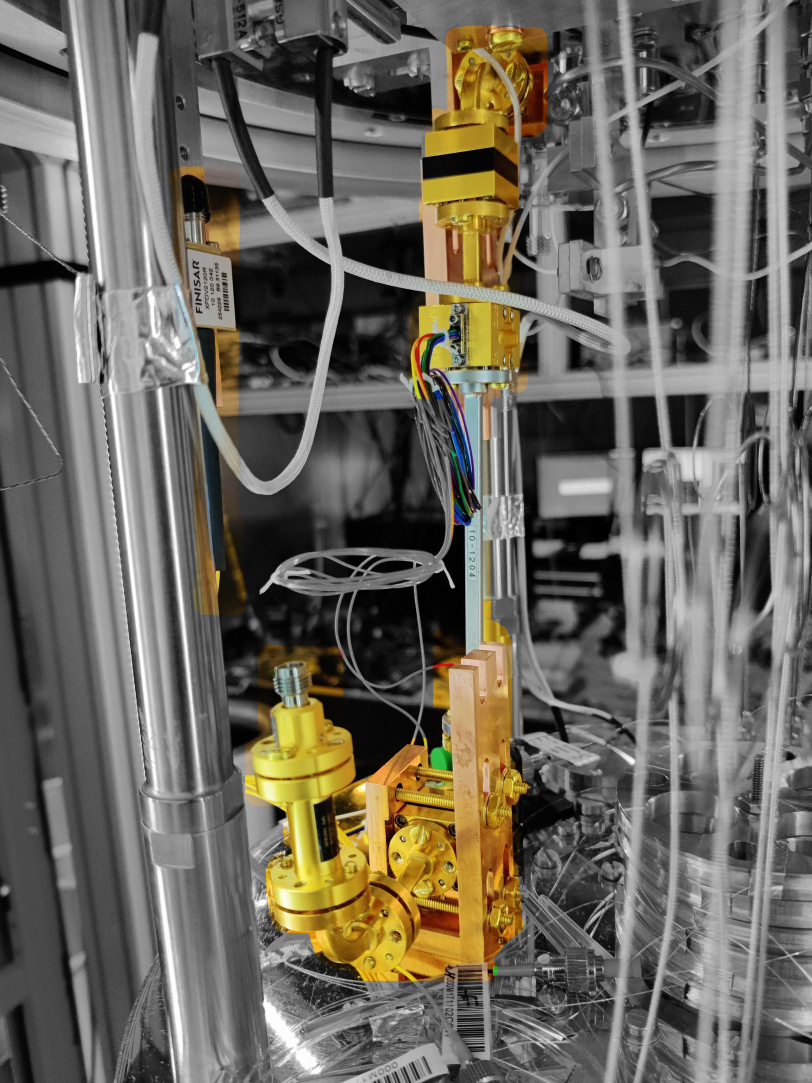
Microwave signals can be measured with superconducting qubits. Optical photons can be detected with extremely high precision. But in between lies a poorly explored region – the terahertz gap.
“We know dark matter exists from astronomical observations, but we don’t know what it is,” Nanni said. “Candidate particles span an enormous mass range, which means the frequencies we must search across are equally broad. Detecting them requires extraordinary sensitivity.”
The problem? No one has successfully built qubits that operate in the terahertz regime. Rather than inventing an entirely new class of detectors from scratch, Nanni’s group has focused on quantum transduction, converting photons from one frequency into another without destroying the quantum information they carry.
Quantum sensing: Four bars on Mars
Quantum sensing uses quantum phenomena to detect extremely subtle signals or changes that are beyond the reach of many traditional sensors.

“There’s no single sensor that works across all frequencies,” he said. “Quantum transducers are especially powerful because they convert signals into frequencies where sensors perform best.”
In the program’s first phase, the team pursued two complementary strategies. One focused on superconducting devices designed to connect microwave and millimeter-wave frequencies – work that remains ongoing. The other led to a major milestone: a chip-scale device that converts millimeter waves into optical light while approaching fundamental quantum limits.
Associate Professor of particle physics and astrophysics and of photon science at SLACThis is the first chip-scale frequency converter to approach quantum limits.

“This is the first chip-scale frequency converter to approach quantum limits,” Nanni said.
By the end of this phase, he added, “we expect to have sensors operating in frequency regimes that have been extremely challenging to probe.”
Harnessing quantum bits
For SLAC scientist Noah Kurinsky, QuantISED began as an extension of work in his lab focused on building sensors out of qubits, the same devices used in quantum computers.
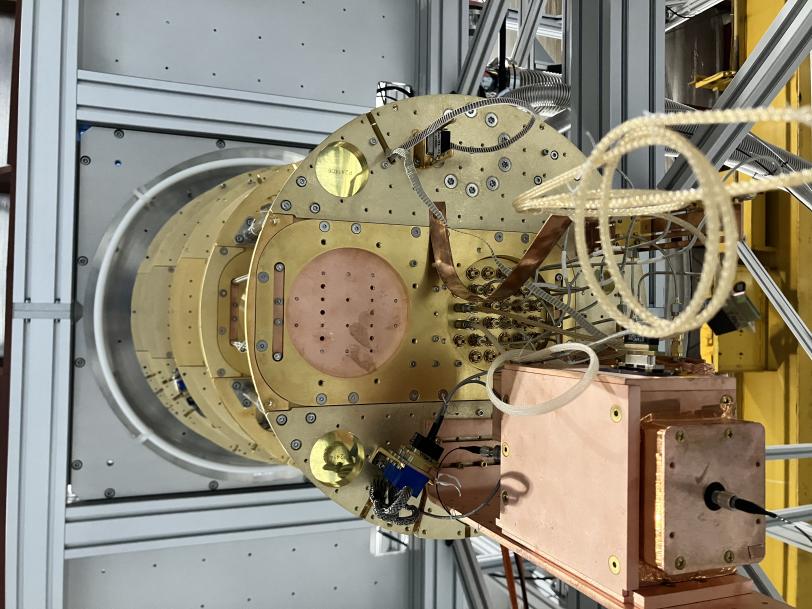
“Superconducting qubits are extremely sensitive to terahertz photons,” Kurinsky said. “What if we exploited that sensitivity and turned it into a sensor for detecting dark matter? That’s the pitch.”
In quantum computing, stray radiation, especially in the terahertz range, is something engineers try to eliminate because even a single absorbed photon can disrupt a qubit’s state. Kurinsky’s group is taking the opposite approach: using that extreme sensitivity to their advantage, with the goal of detecting individual terahertz photons.
Superconducting qubits: Delicate powerhouses
Superconducting quantum bits, or qubits, act like supercharged versions of the classical bits, allowing for extremely fast quantum operations, often completed in billionths of a second.

To make that happen, his group has been building the pieces needed to test that idea: not just qubit-based sensors, but the infrastructure required to calibrate them. A key effort involves developing a tunable terahertz photon source capable of delivering controlled signals into a dilution refrigerator, where the sensors operate just above absolute zero. At those temperatures, even tiny imperfections matter.
“For the full system to work, it’s basically several different projects that all have to succeed,” Kurinsky said. “But we have early results on each component, and they’re promising.”
The long-term goal is to build a tunable source of single terahertz photons that can be steered across a detector, so the team can see exactly how it responds. The detector needs to be extraordinarily quiet, registering at most about one false signal per day.
SLAC scientistIf any of this works even remotely well, it opens a largely unexplored window of the electromagnetic spectrum, giving us new ways to search for signals we couldn’t access before.

“That’s a huge experimental challenge,” Kurinsky said. “But if any of this works even remotely well, it opens a largely unexplored window of the electromagnetic spectrum, giving us new ways to search for signals we couldn’t access before.”
The first major application is axion dark matter. Kurinsky’s group is involved in the Broadband Reflector Experiment for Axion Detection (BREAD), a tabletop axion search that aims to scan large regions of unexplored parameter space without the need for massive underground detectors. A reliable single-terahertz-photon source could significantly speed up that search.
While dark matter is the immediate motivation, the implications extend further. Terahertz sensing has potential applications in areas ranging from materials science to non-ionizing biomedical imaging. Kurinsky sees dark matter searches as an opportunity to push detector technology to its limits in ways that often spill over into other fields.
“One way I think about dark matter searches is that they force detector technology to its absolute limits,” he said. “And then those technologies find broader applications.”
In QuantISED 2.0, Kurinsky hopes to move beyond early demonstrations into real measurements.
“Right now, each group has shown that the basic devices work,” he said. “The next step is putting them in front of a real signal and seeing what they can do.”
“Long term, I’d love for this work to help build a durable program at SLAC where we’re a major player in terahertz sources and detectors, with applications in health, defense and more,” he added. “In the short term, if we find dark matter, that would be a pretty exciting bonus.”
Listening for dark matter
At the opposite end of the spectrum, Kent Irwin, a professor of physics at Stanford and professor of photon science and of particle physics and astrophysics at SLAC, is pursuing a different strategy.
Instead of counting photons in the terahertz range, his team is working below a gigahertz, a frequency range where some of the best-motivated axion dark-matter models lie.
At those low frequencies, he says, the rules change.
“Below a gigahertz, you don’t want to use the same quantum technologies used at higher frequencies,” Irwin said.
At higher frequencies, experiments often try to detect individual photons. That strategy makes sense when photons are sparse and can be counted one by one. But at lower frequencies, thermal background photons are unavoidable, even at extremely low temperatures.
Professor of physics at Stanford and Professor of photon science and of particle physics and astrophysics at SLACYou don’t want to count photons. You want something more like a radio: a quantum radio.

“You don’t want to count photons,” Irwin said. “You want something more like a radio: a quantum radio.”
The approach reflects how dark matter behaves at different mass scales. At very low masses, axions would behave less like a stream of individual particles and more like a faint, continuous wave filling all space. Detecting them is less like waiting for a rare particle collision and more like tuning a radio to an unknown station.
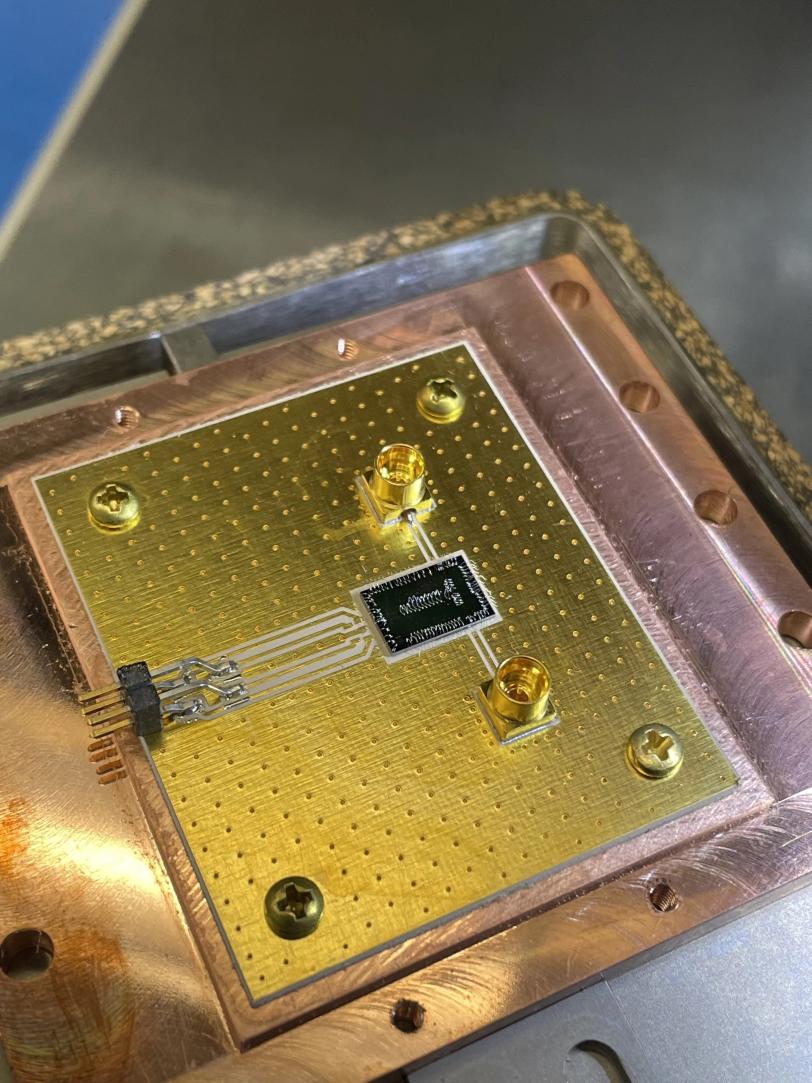
During the first phase, Irwin’s group developed a key enabling technology: a radio-frequency quantum upconverter. The device takes signals in the megahertz range and shifts them into the gigahertz regime, where superconducting electronics can analyze them more efficiently.
“There’s a lot of very mature quantum technology at gigahertz frequencies,” Irwin said.
The work resulted in a 2025 paper describing the technology, which the team calls the “dark matter radio.” Since then, they have continued refining the devices and expanding their applications.
Those tools are not limited to dark matter, however. They also support broader quantum science goals under SLAC’s quantum information science and technology initiative, including entanglement across distance and nuclear-spin measurements.
Quantum networking: The dance of qubits
You can imagine entanglement as two dancers moving in perfect harmony, their steps mirroring each other instantly, no matter how far apart they are. Just as watching one dancer spin left reveals the other is spinning right, measuring one entangled qubit instantly shows the state of the other.

QuantISED 2.0 will rely heavily on SLAC’s new superconducting-focused Device Microfabrication Facility (DMF), which will enable more complex, multilayer quantum devices.
“We’re at the point where the sensors work and we understand them,” Irwin said. “Now we’ll have the fabrication tools to optimize and integrate them. That’s when the really fun part begins.”
Looking further ahead, Irwin sees this effort as part of a larger shift in particle physics. Decades of searches for Weakly Interacting Massive Particles (WIMPs), a hypothesized dark matter candidate, have ruled out large regions of parameter space. Axions remain one of the most compelling alternatives.
“If axions exist, they should be produced in abundance,” Irwin said. “The community ultimately needs to search the full mass range.”
He argues that SLAC’s distinctive contribution has been leadership in the lower-frequency regime, territory that relatively few experiments are exploring.
“This is laying the groundwork for a large-scale effort,” Irwin said. “Something SLAC could potentially lead.”
Probing quantum gravity
Another effort, led by Stanford physicist Monika Schleier-Smith, tackles a different frontier: the relationship between quantum mechanics and gravity.

“Quantum mechanics describes the world at very small scales – atoms and electrons – while Einstein’s theory of gravity describes the universe at astronomical scales,” Schleier-Smith said. “It’s hard to access regimes where both quantum mechanics and gravity matter at the same time.”
Over the past two decades, theorists have explored the idea that gravity might not be fundamental at all but instead could emerge from deeper quantum ingredients – particularly quantum information and entanglement. Schleier-Smith’s group is asking whether aspects of those ideas can be explored experimentally.
“There’s been beautiful theoretical work suggesting that gravity could emerge from quantum mechanics,” she said. “The question is whether there are aspects of this connection that we can test in the lab.”
Her team works with arrays of laser-cooled atoms – highly controlled quantum systems that can be manipulated with extraordinary precision. In their experiments, atoms are trapped in laser light and placed between two mirrors, forming an optical cavity. Photons bounce back and forth inside the cavity, allowing atoms to exchange information through light.
Quantum materials: Tailoring the exotic
Quantum materials behave in unexpected ways compared to the classical materials we are used to. These materials – such as magnets, superconductors and topological insulators – can exhibit unusual properties, like conducting electricity with little or no energy loss, and display quantum phenomena such as superposition and entanglement.

This setup produces interactions that connect distant atoms, rather than only neighboring ones.
“In our lab, photons provide a communication channel,” Schleier-Smith said. “They allow information to move between atoms that aren’t directly next to each other.”
Those engineered interactions let the team study how quantum information spreads, or “scrambles,” across a system, an idea that also appears in discussions of black holes.
During the first phase of QuantISED, they arranged the atoms so they interacted in a specific way and then measured how information spread through the system. When they analyzed the data, a branching, tree-like pattern emerged – one that physicists recognize as a simple model of curved space.
“That was a highlight of our work,” Schleier-Smith said. “It demonstrated a concrete way in which geometry can emerge as a description of correlations in a quantum system. Properties that look like features of space appeared not from the hardware itself, but from patterns of entanglement.”
Looking ahead to QuantISED 2.0, the goal is to move beyond proof-of-principle demonstrations toward true quantum simulation – experiments that explore regimes too complex for classical computers to predict.
“Ideally, we want to reach a regime where we build the system, run the experiment and learn something we couldn’t have calculated beforehand,” Schleier-Smith said.
This requires dramatically stronger interactions between single atoms and photons. Achieving that will involve a new experimental platform developed in collaboration with Nanni’s group: a superconducting millimeter-wave cavity operating at cryogenic temperatures. Unlike previous experiments, where the atoms were ultracold while the apparatus remained at room temperature, this new cavity itself must be cold and superconducting.
“This new platform could improve the coherence of atom–photon interactions by orders of magnitude,” Schleier-Smith said. “It opens the door to exploring entirely new quantum regimes.”
Phase 2 will also expand the theory collaboration. Schleier-Smith’s project now includes theorists at Stanford and beyond who specialize in quantum information and quantum gravity, strengthening the connection between cutting-edge theory and experiment.
Associate Professor of physics at StanfordIn Phase 1, a lot of the work was building the toolbox. Now we’re really aiming to connect those theoretical ideas with experiments in a deeper way.

“In Phase 1, a lot of the work was building the toolbox,” she said. “Now we’re really aiming to connect those theoretical ideas with experiments in a deeper way.”
Putting the tools to the test
While the first round of QuantISED focused on demonstrating that new quantum technologies could work at all, the emphasis is shifting toward integration, optimization and real experiments – the stage where new physics may emerge.
“We’re transitioning from developing the technology to actually turning it into sensors that can be used for physics,” Nanni said.
If successful, the advances made through QuantISED could expand dark matter searches, open new frequency windows for observation and create laboratory systems that explore how gravity and quantum mechanics are connected.
“These are difficult problems,” Kurinsky said. “But if we can build the right tools, we can start to answer them.”
This research is supported by the Department of Energy’s Office of Science. The list of projects and more information can be found on the High Energy Physics program homepage.
About SLAC
SLAC National Accelerator Laboratory explores how the universe works at the biggest, smallest and fastest scales and invents powerful tools used by researchers around the globe. As world leaders in ultrafast science and bold explorers of the physics of the universe, we forge new ground in understanding our origins and building a healthier and more sustainable future. Our discovery and innovation help develop new materials and chemical processes and open unprecedented views of the cosmos and life’s most delicate machinery. Building on more than 60 years of visionary research, we help shape the future by advancing areas such as quantum technology, scientific computing and the development of next-generation accelerators.
SLAC is operated by Stanford University for the U.S. Department of Energy’s Office of Science. The Office of Science is the single largest supporter of basic research in the physical sciences in the United States and is working to address some of the most pressing challenges of our time.
Related stories

Containing multitudes: SLAC scientist collaborates to create scalable qubits